The Real Reason Teams Struggle
Most organizations assume that when teams struggle, the answer lies in improving individual capability which means providing more training, enhancing communication, inculcating greater accountability. Yet teams rarely struggle because they lack talent. They struggle because of the systems within which they operate.
Periods of relative stability can disguise underlying tensions in the form of misalignment being tolerated, dependencies overlooked or competing priorities being managed through individual effort and goodwill.
Until something changes
Enter economic uncertainty, market disruption, geopolitical instability and rising stakeholder expectations. Under pressure, what was once manageable becomes visible.
Conflict intensifies, decision-making slows and trust frays.People become frustrated with one another.And yet what appears to be an internal problem is often something else entirely.
Teams are not only responding to one another. They are responding to the wider environment.
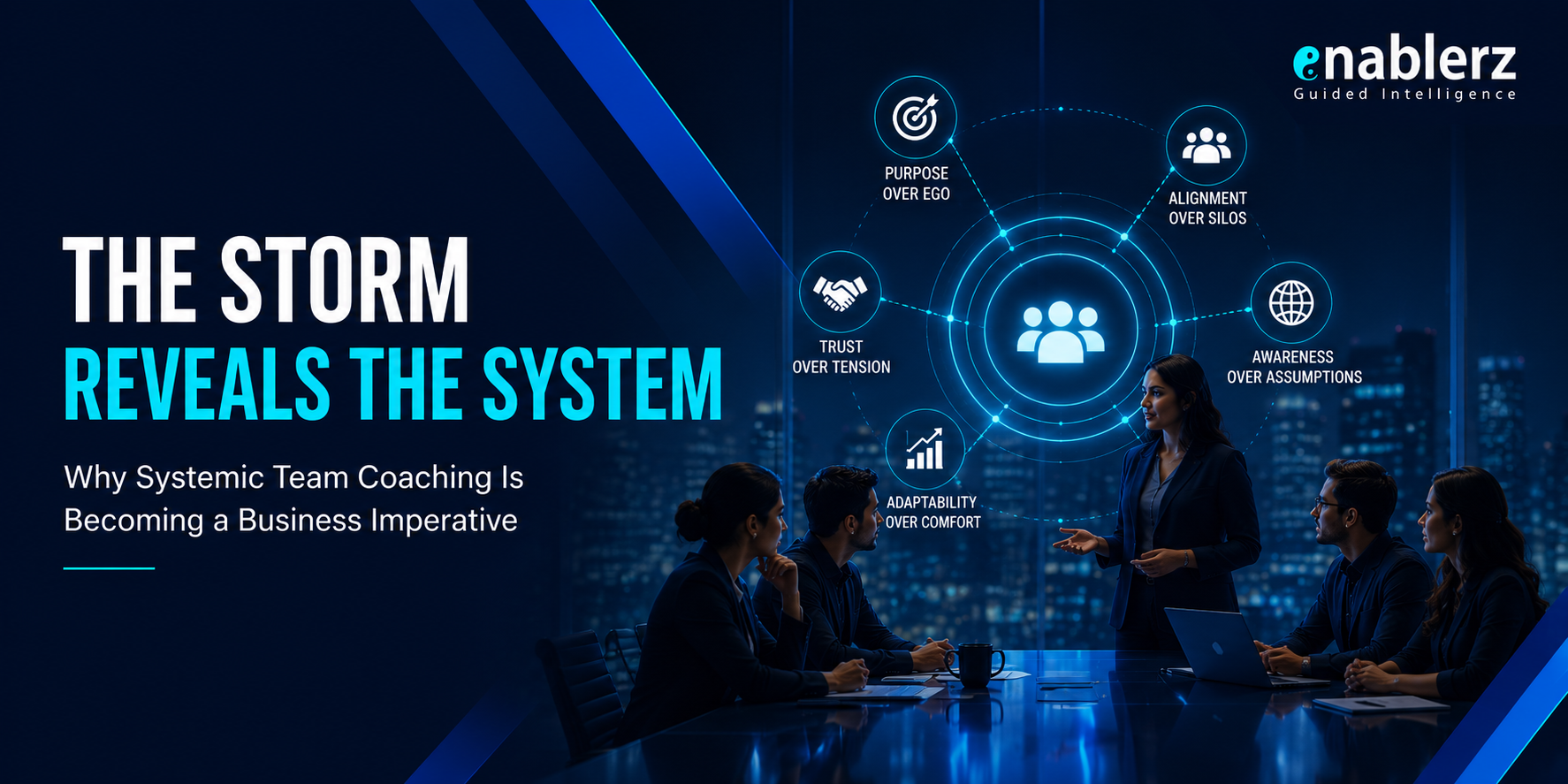
The storm reveals the system.
The "Stress Mirror" Effect
One of the most powerful insights in systemic team coaching is that teams often absorb and reflect the pressures surrounding them. External stress begins to show up internally.
Teams can start blaming each other when, in reality, they are experiencing the weight of competing stakeholder demands, uncertainty, or the emotional impact of events beyond their control. What looks like dysfunction may simply be complexity expressing itself through relationships.
Helping teams recognize this changes the conversation.
Instead of asking: "What's wrong with us?"
Teams begin to ask: "What pressures are acting upon us, and how do we want to respond together?"
The distinction matters. Because one question invites blame.The other invites collective responsibility.
The Myth of Fixing People
Many interventions focus on changing behaviour. Systemic team coaching focuses on changing patterns. It shifts attention away from personalities and toward relationships.
Away from symptoms and toward causes. Away from isolated issues and toward the wider context in which those issues emerge.
As Peter Hawkins reminds us:"We need to coach the connections, not the person."
This is not about avoiding accountability or about creating harmony for harmony's sake. It is about enabling teams to understand the forces shaping their behaviour and strengthening their ability to respond consciously rather than reactively.
Because sustainable performance does not come from fixing people. It comes from guide teams through a journey of self-discovery and alignment, leading to sustainable success.
From Internal Harmony to External Awareness
Increasingly, the challenge facing teams is not simply how to work better together. It is how to remain connected to the wider system they exist to serve.
In fast-moving environments, plans quickly become outdated. Stakeholder expectations evolve, customers' needs shift and communities are impacted.
Teams cannot afford to become consumed by internal dynamics alone.
They must continually ask:
- What are our stakeholders asking of us now?
- Who is influencing our decisions, even if they are not in the room?
- What are we sensing in the wider environment?
- How do we remain useful in the midst of uncertainty?
Systemic team coaching helps teams expand their awareness beyond the boundaries of the meeting room.
Collective Leadership in an Age of Complexity
From Nice-to-Have to Strategic Imperative
For many organizations, coaching is still viewed as a developmental intervention or a cultural aspiration. But systemic team coaching represents something much more fundamental. It is a strategic need.
And when the next storm arrives as it inevitably will the question will not simply be whether individual leaders are strong enough. The question will be whether the system itself is resilient enough.
Ultimately, sustainable performance is not built by heroic individuals. It is built through healthy systems.
And perhaps the most important question leaders can ask themselves is not:
"How do we fix our people?"
But rather:
"What patterns is our leadership system currently reinforcing? And are those patterns serving the future we are trying to create?"
About Enablerz: Enablerz is an AI-native coaching platform that makes professional coaching accessible to every employee — not just the senior team. Our MOAI™ AI coach and ENA™ enterprise platform serve individuals and organisations across India and beyond.