Why the First-Time Manager Transition Is So Hard
The skills that made someone an excellent individual contributor — technical expertise, deep focus, personal productivity, self-reliance — are almost entirely different from the skills required to lead a team effectively.
As an individual contributor, your success is largely in your own hands. As a manager, your success depends on how well you enable others. That shift is not incremental. It is structural. And yet most organisations treat it as a natural progression rather than a fundamentally different role requiring fundamentally different development.
The result: 67% of first-time managers report feeling underprepared when they first took on a leadership role (Harvard Business Review). In India, where management promotions are often rapid in high-growth sectors, that number is likely higher.
Coaching doesn't fix this with a framework or a workshop. It fixes it by giving new managers a consistent, private space to think through the real challenges — the ones they don't feel comfortable raising with their manager or their team.
The 7 Things Nobody Tells First-Time Managers
1. You Can't Do It Yourself Anymore — and That's Terrifying
Your instinct when something goes wrong is to step in and fix it. You know how. It would take you 20 minutes. Watching a team member struggle through it in three hours is genuinely painful.
But every time you step in and do it for them, you send a signal: I don't trust you to figure this out. That signal compounds. Teams become dependent. Managers become bottlenecks.
The hardest skill in early management is learning to hold back — to ask questions instead of giving answers, to let people struggle productively instead of rescuing them.
How coaching helps: A coach helps you recognise your rescue instinct, understand what's driving it (often a need for control or fear of failure), and develop the questions that enable your team rather than the actions that replace them.
2. Feedback Is the Most Important Skill You Don't Have
Nobody teaches feedback. Not really. Most managers learned by receiving bad feedback — or no feedback at all — and are now expected to deliver it constructively under pressure.
The consequences of avoiding feedback are significant: performance issues fester, team members don't grow, trust erodes. The consequences of delivering it badly are worse: relationships break down, people disengage, your best performers leave for managers who actually develop them.
How coaching helps: Coaching gives new managers a rehearsal space. They can work through specific feedback conversations before they happen — what to say, how to frame it, how to handle the reaction. This practice, in a private, non-judgmental space, changes the actual conversation.
3. Your Relationship with Your Team Has Permanently Changed
The people who were your peers last month are now your direct reports. The Friday night drinks. The group chat. The shared eye-rolls about management decisions.
That social context doesn't disappear — but it must change. And navigating that change, while maintaining relationships and managing performance, is genuinely complex. Most new managers either overcorrect (becoming cold and transactional) or undercorrect (trying to stay 'one of the team' and losing authority).
How coaching helps: Coaching helps new managers clarify the new relational boundaries — not through rules, but through understanding what they actually need from their team relationships now, and how to communicate that transition with honesty and respect.
4. You Are Now Responsible for Things You Cannot Control
As an individual contributor, accountability was relatively clean. You did the work; the outcome was largely yours.
As a manager, you are accountable for the work of people whose performance depends on factors you can influence but rarely control — their motivation, their circumstances, their skills, their history with the organisation.
This is profoundly disorienting. Many new managers respond with micromanagement — an attempt to restore the sense of control they had as individual contributors. It's the wrong response, but it's entirely understandable.
How coaching helps: Coaching helps managers reframe accountability — from 'I am responsible for the outcome' to 'I am responsible for creating the conditions for the outcome'. That shift changes everything about how they manage.
5. Imposter Syndrome Peaks at Exactly This Moment
You've been promoted. You should feel confident. Instead, you feel like a fraud — convinced that any day now, someone will realise they made a mistake.
This is extraordinarily common among first-time managers, and particularly acute in high-performance cultures (India's tech and consulting sectors) where the expectation of competence is ever-present and the margin for visible struggle is perceived as small.
How coaching helps: Coaching separates the feeling of inadequacy from the reality of performance. It helps managers identify where the imposter narrative is simply untrue — and where there are genuine skills gaps worth addressing. Both are useful. Neither requires suffering in silence.
6. No One Prepares You for the Emotional Weight
Two people on the team are in conflict and both come to you separately. Someone tells you in confidence that they're being treated unfairly by a senior stakeholder.
New managers carry an emotional load that nobody mentioned in the job description. They absorb the stress of their team. They navigate competing loyalties between the organisation and the people they lead. They make decisions that affect people's livelihoods.
How coaching helps: Coaching creates a container for the emotional weight — a private space where managers can process what they're carrying without burdening their team upward or their own manager. That processing protects both the manager's wellbeing and the quality of their decisions.
7. Your Manager Has No Idea How Much Support You Need
Your manager promoted you because they believed in you. They are also busy, managing their own pressures, and may assume that because you're not asking for help, you don't need it. Or they may have forgotten how hard the first year of management was.
The help you need is not tactical — it's not how to run a one-on-one or how to write a performance review. It's the deeper, harder questions: Am I becoming the leader I want to be? What is my actual leadership style? How do I handle this situation in a way I'll respect myself for?
How coaching helps: Coaching fills the gap that management structures consistently leave open. It's not about replacing the manager-manager relationship — it's about giving new managers a space to develop at the depth their role now demands.
What Organisations Lose Without This Support
The cost of under-supporting first-time managers is not theoretical. It manifests in:
• High early-tenure attrition — both of the new manager and the team they lead
• Toxic team cultures that form in the absence of good management practice and compound over years
• Burnout at the manager layer — the group most likely to experience burnout without adequate development support
• Disengagement of high-potential team members who leave because their manager couldn't develop them
• Lost leadership pipeline — when first-time managers fail, organisations often write them off rather than recognise the failure was structural
The investment in coaching first-time managers is not a soft benefit. It is a structural return on the promotion investment the organisation has already made.
Coaching for First-Time Managers: What It Looks Like in Practice
For individuals, coaching for a new manager typically involves:
-
A structured exploration of the transition — what has changed, what old habits need to shift, what new skills are most urgent
-
Working through real, live situations from the week — a difficult conversation, a team dynamics challenge, a stakeholder relationship
-
Building self-awareness as a leader — understanding your default style, your triggers, and how your team experiences you
-
Developing the confidence to lead authentically rather than performing a version of leadership borrowed from someone else
With AI coaching platforms like MOAI™, this support is available between formal coaching sessions — when the difficult moment actually happens, not when the next appointment is scheduled.
For HR Teams: How to Build First-Time Manager Coaching Into Your Organisation
The most effective approach is not a one-off workshop or a coaching programme offered to a select few high-potentials. It is systematic coaching access at the point of transition — when someone is promoted into management.
• Define the transition point clearly: the coaching offer should activate at promotion, not six months later when patterns have already formed
• Make it private and non-evaluative: managers will only engage authentically if they trust the coaching relationship is confidential
• Combine human and AI coaching: AI coaching for immediate, 24/7 support; human coaches for complex, ongoing development
• Measure it: track team retention, engagement scores, and 360 feedback for coached vs non-coached managers to build the internal ROI case
Frequently Asked Questions
Q: What is first-time manager coaching?
A: First-time manager coaching is a structured development process that helps new people managers navigate the transition from individual contributor to leader. It addresses the skills, mindset shifts, and emotional challenges specific to leading a team for the first time — through a combination of guided reflection, practical skill-building, and real-time problem-solving.
Q: When should a first-time manager start coaching?
A: Ideally at the point of promotion — before patterns form and before the inevitable first difficult situation arrives. Early coaching is preventive and developmental. Late coaching is often remedial and harder to engage with. The most effective organisations build coaching into the promotion process itself.
Q: How is coaching different from management training?
A: Training delivers knowledge and frameworks. Coaching applies them to real situations. A training programme might teach you the principles of feedback; a coaching session helps you work through the specific feedback conversation you need to have next Tuesday. Both have value, but training without coaching rarely produces lasting behaviour change.
Q: Can AI coaching help first-time managers?
A: Yes — particularly for in-the-moment support. When a new manager needs to think through a difficult conversation, process a team conflict, or build confidence before a challenging meeting, AI coaching is available immediately and confidentially. Platforms like MOAI™ by Enablerz are specifically designed for this kind of real-time developmental support.
Q: What's the ROI of coaching first-time managers?
A: The ROI is substantial. First-time manager failure costs organisations 50–200% of that manager's salary in replacement costs — plus the secondary attrition of team members who leave under poor management. Coaching at the transition point costs a fraction of this. Organisations that track coaching ROI consistently find it among the highest-returning L&D investments.
Q: Is manager coaching available for small and medium businesses?
A: Yes — and AI coaching platforms have made it significantly more accessible. Traditional 1:1 coaching with a certified coach is expensive and difficult to scale. AI coaching platforms like MOAI™ make it possible to offer coaching to every manager in an organisation, regardless of size or L&D budget
Key Takeaways
• The transition from individual contributor to manager is structurally different — not just a step up, but a different job requiring different skills.
• The average manager waits 10 years after taking on leadership before receiving formal development. Coaching closes that gap immediately.
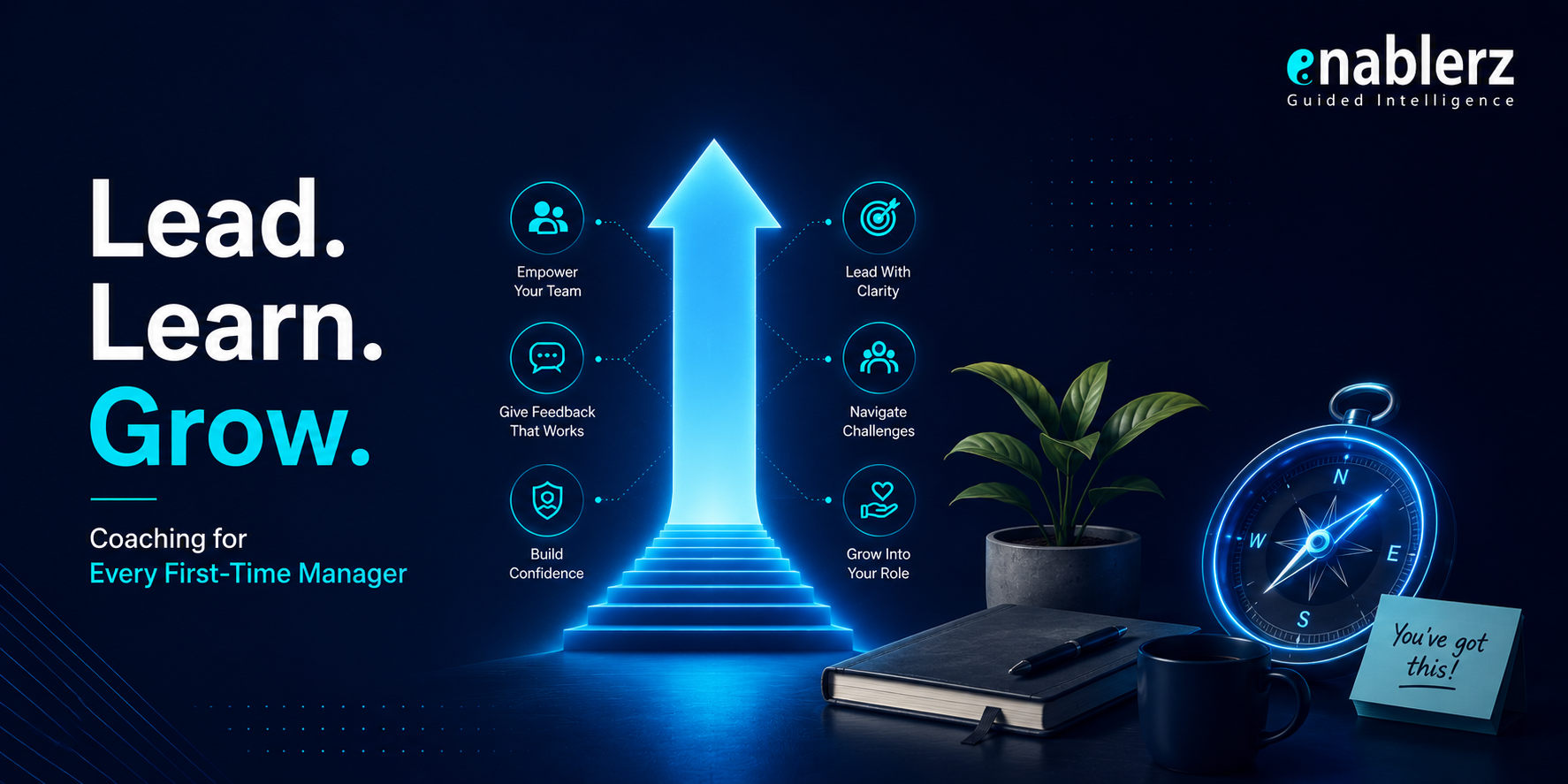
• The 7 biggest first-time manager challenges — delegation, feedback, relationship change, accountability, imposter syndrome, emotional weight, and lack of support — are all addressable through coaching.
• The cost of under-supporting new managers is high: team attrition, disengagement, burnout, and lost leadership pipeline.
• AI coaching makes first-time manager support available in the moment — when the difficult situation actually happens.
• For HR teams: coaching should activate at the point of promotion, not six months later when patterns have already formed.
Take Action
• Try MOAI™ — Enablerz's AI coaching platform for first-time managers needing real-time, confidential developmental support.
• Explore ENA™ — for wanting to build systematic coaching into their first-time manager experience.
About Enablerz: Enablerz is an AI-native coaching platform that makes professional coaching accessible to every employee — not just the senior team. Our MOAI™ AI coach and ENA™ enterprise platform serve individuals and organisations across India and beyond.