What Is Coaching? The Clearest Definition
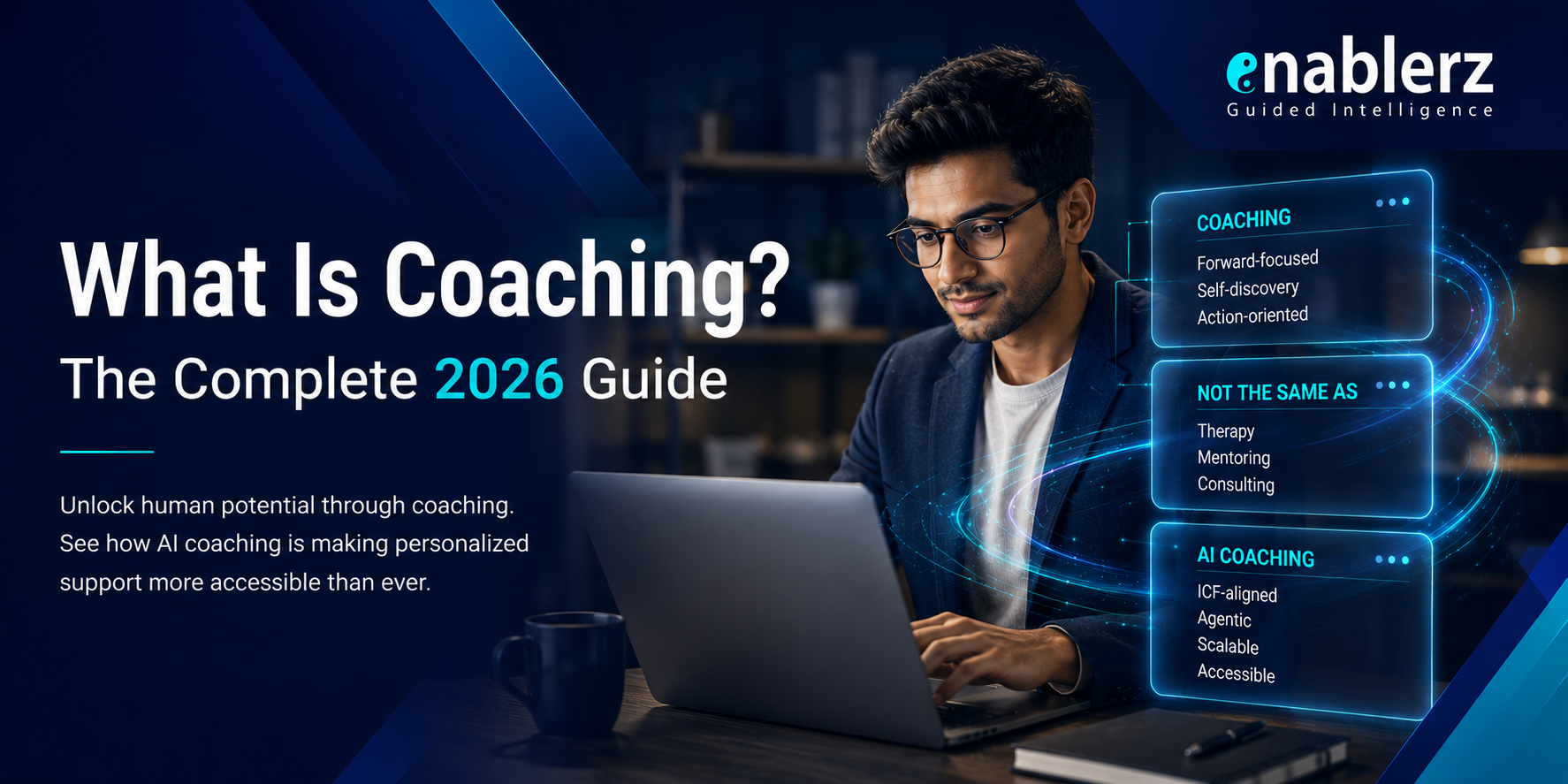
Coaching is a structured, forward-focused conversation process designed to help an individual think more clearly, make better decisions, and take meaningful action toward a defined goal. A coach does not give advice. Does not tell you what to do. Does not fix your problems for you. Instead, a coach asks the right questions — questions you haven't thought to ask yourself — to help you access the clarity, capability, and confidence that's already within you.
The part most people miss: coaching is not about the coach's wisdom. It's about unlocking yours. The International Coaching Federation (ICF) — the world's largest and most respected professional coaching body — defines coaching as: partnering with clients in a thought-provoking and creative process that inspires them to maximise their personal and professional potential. In plain language: coaching is structured, professional thinking time. With someone trained to help you think better — not to think for you.
The three defining elements of coaching:
• Structured — not a casual chat. There is a goal, a process, and intentional direction to every session.
• Forward-focused ,works with where you are now and where you want to go. Not why you ended up here.
• Client-led. The agenda is yours. The coach follows your thinking, challenges it, and helps you move it.
What Coaching Is NOT — And Why These Distinctions Matter Clinically
These are not just semantic differences. They determine whether someone gets the right kind of support for their actual situation. Getting this wrong wastes time, money, and in some cases delays genuinely needed help.
Coaching vs Therapy
-
Therapy is a clinical practice conducted by licensed mental health professionals. It explores the past — healing psychological wounds, treating diagnosed conditions, processing trauma. It is the right intervention when someone needs clinical care.
-
Coaching assumes the person is psychologically healthy. It focuses entirely on the present and future, where you want to go, what's getting in the way, and how to move forward. The two are complementary, not interchangeable.
Key distinction: Therapy heals the past. Coaching builds the future.
When Stress Becomes Clinical: The Prevention Layer the World Is Missing
This is the section most coaching guides leave out. And it's one of the most important. Stress and anxiety exist on a spectrum. For most professionals — and increasingly for students — stress is a daily reality. Manageable. Uncomfortable. But functional. The problem is that when chronic, unaddressed stress crosses into clinical territory, the transition is rarely obvious. Not to the person experiencing it. Not to the people around them. And not to the organisation responsible for their wellbeing.
What clinical depression and anxiety look like when they overflow
The clinical signs that stress has moved from manageable to diagnosable include:
Behavioural overflow signals:
- Complete withdrawal from social and professional interactions — not disengagement, but absence
- Inability to perform basic functions of the role despite trying — not underperformance, but paralysis
- Persistent physical symptoms with no medical cause: headaches, insomnia, appetite disruption, chronic fatigue
- Self-medication behaviours — alcohol, substance use, compulsive behaviours — as coping mechanisms
- In severe cases: expressions of hopelessness, self-harm ideation, or suicidal thinking
Cognitive and emotional overflow signals:
- Persistent low mood lasting more than two weeks — not sadness, but a flat, grey absence of feeling
- Inability to experience satisfaction or pleasure in things that previously provided it (anhedonia)
- Catastrophic thinking patterns that cannot be interrupted by logic or reassurance
- Severe concentration impairment — an inability to read, follow a conversation, or complete a sentence of thought
- A pervasive sense of worthlessness or shame that feels permanent and unshakeable
The critical prevention gap — and where coaching sits
Here is the problem the world has not yet solved: The journey from 'stressed but functional' to 'clinically unwell' takes months. Sometimes years. During that entire window, most people receive no structured support whatsoever.
| Stage | Typical Reality |
|---|---|
| 🟢 Mild Stress | Wellness app, self-help resources |
| 🟡 Moderate Stress | EAP, manager conversations, occasional leave |
| 🟠 Severe Stress | HR intervention, therapy referrals, burnout management |
| 🔴 Clinical Crisis | Psychiatry, psychology, medication and intensive support |
Coaching is the prevention layer that currently sits empty in that table. It operates in the first two rows — where professional support is essentially absent. It helps people recognise what's happening early, make sense of it, build coping capacity, and take action before the situation escalates into clinical territory.
The absence of this prevention layer is one of the most significant gaps in workplace and personal wellbeing globally. AI coaching — available 24/7, without stigma, at a fraction of the cost of traditional support — has the potential to fill it at scale.
Coaching vs Mentoring, Consulting & Training
Coaching vs Mentoring
-
A mentor has walked your path and shares their experience. They introduce you to their network, offer guidance based on what worked for them, and give advice rooted in their own journey. Mentoring is largely advice-driven.
-
A coach may know nothing about your specific industry — and doesn't need to. Their value isn't expertise in your field. It's expertise in helping you think. A skilled coach can work equally effectively with a cardiac surgeon, a startup founder, and a first-year university student in the same afternoon.
Key distinction: A mentor gives you a map. A coach helps you draw your own.
Coaching vs Consulting
-
A consultant is hired for their expertise. You bring a problem; they analyse it and deliver a solution or recommendation. The answer comes from them.
-
In coaching, the answer comes from you. The coach's job is to help you access your own knowledge, challenge the assumptions getting in your way, and find solutions you already have the capacity to implement — and own.
Key distinction: A consultant gives you fish. A coach teaches you to fish and helps you figure out which river to stand in.
Coaching vs Training
-
Training delivers knowledge and skills through instruction. It's episodic. You attend a session, absorb the content, and leave.
-
Coaching changes behaviour — not just knowledge. Research consistently shows that training without coaching has minimal impact on actual behaviour change. The Ebbinghaus forgetting curve tells us that without integration, 70% of training content is forgotten within 24 hours. Coaching is the integration layer.
Key distinction: Training fills your head. Coaching changes how you act.
The 8 Types of Coaching and When Each Is Right
Coaching is not a single offering. The type that's right depends entirely on your goals, your situation, and where you are in your life or career.
1. Life Coaching: Focuses on personal goals, life direction, and overall fulfilment. Most valuable for individuals navigating significant transitions — career changes, relationship shifts, or a general sense of 'is this it?' Life coaches help clarify values, set meaningful goals, and build momentum toward a life that feels intentional.
2. Career Coaching: Targets professional direction, career transitions, and positioning. Increasingly in demand as career paths become non-linear — particularly in India, Australia, and the UAE where professionals frequently move across sectors, geographies, and functions.
3. Leadership Coaching: Develops the human skills that management demands: feedback, delegation, trust-building, decision-making under pressure, and navigating team dynamics. Most valuable — and most under-delivered — at the first-time and mid-manager level, where culture is actually built.
4. Executive Coaching: Designed for senior leaders whose decisions affect whole organisations. Focuses on strategic thinking, leadership philosophy, board relationships, and sustaining effectiveness at the top. Historically the most resource-intensive and least accessible type of coaching.
5. Wellbeing & Burnout Coaching: Addresses the prevention and early intervention of burnout, stress, and disengagement. Most effective before full burnout — in the functional-but-depleting stage where most professionals receive no support. Works by helping individuals identify what's depleting them, rebuild agency, and take structural action.
6. Team Coaching: Works with an entire team as the unit of change. Helps teams clarify shared purpose, resolve dynamics, improve collaboration, and build collective performance. Increasingly relevant in hybrid and remote-first environments where team cohesion doesn't happen by proximity.
7. Career Coaching for Students & Young Professionals:
Coaching starts at 18 and sometimes earlier.
One of the most underserved coaching audiences is also the one with the longest runway: students and young professionals between 18 and 25. Career decisions made between 17 and 22 have disproportionate long-term consequences. University subject selection. Whether to pursue higher education or enter the workforce. Which industry to start in. Whether to take a gap year or push straight through. These decisions are made under enormous pressure, with limited self-knowledge, enormous external expectation, and almost no structured support. Family gives advice rooted in their own generation's world. School counsellors manage caseloads too large for meaningful individual engagement. Peers are equally confused.
Coaching for students addresses:
- Subject and stream selection — matching academic choices to actual interests, values, and strengths, not just scores
- University and college decision-making — beyond rankings, what environment and course structure will you actually thrive in?
- Gap year planning — if someone wants one, coaching helps make it intentional rather than avoidant
- Early career positioning — how to approach internships, first roles, and the identity shift from student to professional
- Postgraduate decisions — MBA, Masters, PhD — is it the right move, the right time, and the right reason?
- Managing the pressure of expectation — family, peers, social comparison — without losing clarity on your own direction
The 18-year-old starting university — whether in Asia, the Middle East, Europe, or the Americas — is navigating questions of identity, purpose, and direction that will shape the next decade. Coaching at this stage, even three or four sessions, can save years of misalignment.
AI coaching has made this accessible in a way that was previously impossible. A student doesn't need to afford $180 a session. They need a structured, intelligent conversation that helps them think more clearly about what they actually want — and why.
8. AI Coaching — Agentic, Structured, ICF-Aligned:
- What an agentic AI coach actually is: AI coaching is the most rapidly evolving — and most misunderstood — category in the coaching industry. Let's be specific about what it is, and equally specific about what it is not.
What MOAI™ is — Enablerz's agentic AI coach:
MOAI™ is not a chatbot. It is not a question-and-answer tool built on a general-purpose language model. It is a purpose-built, AI-native coaching system designed exclusively for coaching — and nothing else. Built on Enablerz's proprietary coaching framework and aligned with the ICF's AI coaching guidelines, MOAI™ operates as an agentic AI coach — meaning it doesn't just respond to what you say. It actively guides you through a structured coaching journey, tracks your progress across sessions, builds on what it knows about your goals and patterns, and adapts its approach based on where you are in your development.
What Makes MOAI™ Different from a General AI Tool?
◉ Purpose-Built for Coaching Designed exclusively for coaching, not repurposed from a general AI model. Every interaction is grounded in ICF coaching competencies.
◉ Agentic Architecture MOAI™ is designed to actively support your development journey. It focuses on moving you forward, not simply responding to prompts.
◉ Proprietary Coaching Framework Powered by Enablerz's structured coaching methodology, developed by ICF-certified coaching experts.
◉ ICF-Aligned AI Coaching Built in accordance with the International Coaching Federation's published guidelines for ethical and effective AI coaching.
◉ Structured Development Journey More than a standalone conversation. Sessions connect over time, progress is tracked, and meaningful patterns are recognized.
◉ Advanced Conversational Intelligence Delivers natural, human-quality dialogue that feels like a genuine coaching conversation rather than a questionnaire or form.
Alternative (More Modern)
-
Purpose-Built for Coaching
-
Agentic & Goal-Oriented Architecture
-
Proprietary Enablerz Coaching Framework
-
ICF-Aligned AI Coaching Standards
-
Structured Growth Journey & Progress Tracking
-
Human-Like Conversational Intelligence
What MOAI™ Is Not:
- Not a General-Purpose AI Assistant
MOAI™ was built specifically for coaching, not adapted from a generic AI model for coaching conversations.
- Not a Therapy Tool
MOAI™ does not diagnose, treat, or manage clinical mental health conditions, nor is it a substitute for licensed mental health professionals.
- Not a Replacement for Human Coaches
In complex, high-stakes, or deeply emotional situations, human coaches remain essential. MOAI™ is designed to complement, not replace, human expertise.
- Not an Information Chatbot
MOAI™ doesn't focus on providing answers. It facilitates reflection through powerful questions that help individuals discover their own insights and solutions.
What to Look for When Choosing an AI Coaching Platform
Not all AI coaching tools are equal. As the category grows, the gap between genuine coaching tools and rebranded chatbots is widening — and knowing the difference protects your investment, your people, and your outcomes.
For individuals — what to look for?
7 Things That Separate a Real AI Coaching Platform from a Coaching-Branded Chatbot
-
Purpose-Built for Coaching Was it designed by coaching experts from the ground up, or is it a general AI with a coaching persona layered on top? A true coaching platform is built around coaching principles, not adapted to them.
-
Alignment with ICF Standards The International Coaching Federation (ICF) has published guidelines for AI coaching. Credible platforms align with these standards to ensure ethical and effective coaching practices.
-
Structured Journey, Not Just Sessions Real coaching happens over time. Effective platforms track progress, build on previous conversations, recognize patterns, and help users move toward defined goals. Chatbots start from scratch every time.
-
Agentic Capability Does the platform actively guide development, or simply react to messages? An agentic AI coach has developmental objectives and helps users move forward with intention.
-
Clear Boundaries Responsible coaching platforms clearly define what they do not handle, including clinical mental health conditions, crisis situations, and therapeutic interventions, while providing guidance on where to seek appropriate support.
-
Data Privacy & Confidentiality Coaching conversations often involve sensitive personal information. Users should understand exactly how their data is collected, stored, used, and protected.
-
Access to Human Coaches The strongest coaching ecosystems are hybrid. When situations become complex, emotional, or high-stakes, users should have the ability to connect with a qualified human coach.
The Bottom Line
- A coaching-branded chatbot responds to conversations. A true AI coaching platform supports growth, tracks progress, respects coaching standards, and helps people move toward meaningful outcomes.
For HR leaders and organisations — what to evaluate?
8 Criteria for Evaluating an AI Coaching Platform at Enterprise Scale
-
Coaching Credibility & ICF Alignment Who designed the coaching framework? Is it aligned with ICF standards? The strongest platforms are built with direct involvement from experienced coaching professionals, not solely by technology teams.
-
Agentic vs. Reactive Architecture Does the platform actively guide employees through a structured development journey, or simply respond to prompts? Agentic coaching platforms drive progress and accountability, delivering significantly stronger outcomes.
-
Enterprise Integration Capability Can it connect with your HRIS, competency framework, LMS, and broader L&D ecosystem? Coaching that operates outside existing systems rarely achieves enterprise-scale impact.
-
Analytics & Impact Measurement Can leaders track coaching effectiveness through aggregated insights such as goal progression, engagement levels, development themes, and sentiment trends? If impact cannot be measured, it cannot be managed.
-
Human Coach Escalation Pathway When an employee's needs exceed the scope of AI coaching, is there a seamless transition to an ICF-certified human coach? Responsible deployment requires a clear escalation mechanism.
-
Data Governance & Compliance Where is employee data stored? Who has access? How is confidentiality protected? Enterprise platforms should demonstrate compliance with regulations such as DPDPA (India), the Privacy Act (Australia), and relevant UAE data protection frameworks.
-
Clinical Safeguards & Risk Management Can the platform recognize indicators of severe distress and respond appropriately? Mature AI coaching solutions incorporate safeguards and escalation protocols. General-purpose chatbots typically do not.
-
Deployment Flexibility & Scalability Can the same platform effectively support first-time managers, emerging leaders, senior executives, and students? Enterprise-ready solutions are designed to scale across diverse user groups and development needs.
The Enterprise Test
A true enterprise AI coaching platform is not just intelligent. It is coach-credible, agentic, measurable, secure, compliant, and designed to scale across the entire talent ecosystem.
How ENA™ Addresses These Criteria
- ICF-Certified Human Coaches on Every Engagement
Every coaching engagement is supported by ICF-certified coaches, ensuring adherence to the highest globally recognised coaching standards.
- Purpose-Built, Agentic AI with MOAI™
MOAI™ is designed specifically for coaching and development. It is not a repurposed general AI assistant, but an agentic coaching platform built to drive growth and progress.
- AI-Powered Coaching Matchmaking
Intelligent matching aligns employees with the most suitable coaches based on organisational competencies, development priorities, and business goals.
- Enterprise Analytics & Impact Visibility
A comprehensive analytics dashboard provides HR and L&D teams with aggregated insights into coaching impact, sentiment trends, engagement levels, and goal progression.
- Seamless AI-to-Human Coaching Continuum
MOAI™ delivers scale, accessibility, and immediacy, while ENA™ provides the depth, nuance, and expertise of human coaching when required.
- Built-In Clinical Safeguards
MOAI™ is designed to recognise indicators of emotional distress and guide individuals toward appropriate support channels when coaching is no longer the right intervention.
The ENA™ Advantage
ENA™ combines the scalability of AI with the credibility of ICF-certified human coaching, creating a coaching ecosystem that is intelligent, responsible, measurable, and enterprise-ready.
Coaching in a Global Context
Professional coaching is now a global discipline — practised, accredited, and growing across every major economy. While the maturity of coaching markets varies, the underlying need is universal: professionals at every level, in every geography, benefit from structured thinking support.
Emerging and high-growth markets
Across Asia, the Middle East, and Latin America, coaching adoption is accelerating — driven by rapid professionalisation, high-growth sectors, increasing HR sophistication, and a young workforce demanding development as a baseline expectation. In these markets, the opportunity is largest: demand is growing fastest, supply of qualified coaches is still catching up, and AI coaching platforms offer the clearest path to scale.
Traditional 1:1 coaching in these markets typically costs $80–$400 per session depending on coach experience and sector. AI coaching makes professional-quality coaching accessible at a fraction of this, a critical enabler in markets where per-session pricing puts coaching out of reach for most professionals.
Mature Western markets
In North America, Western Europe, and the Asia-Pacific region, coaching is an established professional discipline with strong accreditation infrastructure, widespread corporate adoption, and significant ICF membership. The gap here is not awareness — it's scale. Coaching remains largely inaccessible below the senior leadership tier. Platforms that bring coaching to the manager and employee level are closing this gap.
The global cost reality and what AI coaching changes
Globally, traditional executive coaching costs $200–$600 per session. At that price point, coaching reaches perhaps 5–10% of any organisation. AI coaching changes the economics fundamentally — bringing professional-quality coaching to every employee, at every level, without a per-session price tag. That democratisation is not incremental. It is structural.
Frequently Asked Questions:
Q: What is coaching in simple terms?
A: Coaching is a structured conversation process where a trained coach — human or AI — helps you think more clearly about a goal, challenge, or decision. The coach asks powerful questions; you find your own answers. It is forward-focused, client-led, and outcome-oriented.
Q: What is the difference between coaching and therapy?
A: Therapy is a clinical intervention — it explores the past to heal psychological wounds and treat diagnosed conditions, conducted by a licensed professional. Coaching is forward-focused — it assumes psychological health and builds clarity, capability, and action. The two are complementary. When stress crosses into clinical territory, therapy is the right call. Coaching is the prevention layer before that point.
Q: Can students benefit from coaching?
A: Yes — significantly. Coaching is highly effective for students aged 18 and above navigating subject selection, university decisions, postgraduate choices, early career positioning, and the pressure of expectation. AI coaching has made this accessible in a way that traditional coaching never was — affordable, available outside university hours, and without the stigma of formal 'help'.
Q: What is an agentic AI coach?
A: An agentic AI coach actively guides you through a structured coaching journey — it has goals for your development, tracks your progress across sessions, builds on what it knows about you, and adapts its approach over time. This is fundamentally different from a chatbot, which simply responds to what you type. MOAI™ by Enablerz is an agentic AI coach built exclusively for coaching, aligned with the ICF's AI coaching guidelines.
Q: Is AI coaching as effective as human coaching?
A: AI coaching is highly effective for reflection, goal clarity, decision support, in-the-moment support, and building self-awareness through regular engagement. The most effective model is hybrid: AI coaching for scale, immediacy, and 24/7 availability; human coaching for depth, emotional complexity, and sustained relationship. MOAI™ and ENA™ work together in exactly this way.
Q: What should I look for in an AI coaching platform?
A: Look for: purpose-built coaching design (not a general AI repurposed); ICF alignment; agentic architecture (structured journey, not just chat); data privacy and confidentiality guarantees; clinical safeguards for recognising distress; and a human coach escalation pathway for when AI coaching isn't enough.
Q: How is coaching different from mentoring?
A: A mentor shares their own experience and gives advice based on what worked for them. A coach doesn't need to know your industry — their value is in helping you think, not in providing their own answers. Mentoring is advice-driven; coaching is question-driven.
Q: How much does coaching cost?
A: Traditional 1:1 coaching costs $100–$600 per session depending on market and coach level. MOAI™ by Enablerz makes AI coaching available at a fraction of this cost — subscription-based, accessible to individuals and entire organisations. ENA™ scales professional human coaching across an organisation without the per-head cost of traditional models.
Q: Is coaching confidential?
A: Yes — for both human and AI coaching. ICF-certified coaches are bound by a strict code of ethics that includes full client confidentiality. MOAI™ operates with strong data privacy protections. For organisational deployments, individual coaching conversations are never shared with employers — only anonymised, aggregated insights.
Q: What is the ICF and why does it matter?
A: The International Coaching Federation (ICF) is the world's largest and most respected professional coaching body. ICF certification (ACC, PCC, or MCC) requires verified training hours, assessed competency, and commitment to a code of ethics. Every human coach on the ENA™ platform is ICF-certified. MOAI™ is built in alignment with the ICF's published AI coaching guidelines — the only framework of its kind.
Key Takeaways
-
Coaching is a forward-focused development process It helps individuals think more clearly, make better decisions, and take purposeful action. A coach's role is to unlock your thinking, not provide the answers.
-
Coaching is distinct from other forms of support It is not therapy (healing the past), mentoring (sharing experience), consulting (providing solutions), or training (delivering knowledge).
-
Clinical challenges require clinical support When stress progresses into persistent low mood, severe functional impairment, or self-harm ideation, therapy or psychiatry becomes the appropriate intervention. Coaching serves as an earlier, preventative layer of support.
-
Students are one of the most underserved coaching populations The decisions made between 18 and 25 often shape careers, relationships, and life trajectories for years to come. AI coaching is helping make high-quality support accessible at scale.
-
A true AI coach is more than a chatbot Purpose-built, agentic, and ICF-aligned AI coaching platforms like MOAI™ provide structured development journeys rather than isolated conversations.
-
Not all AI coaching platforms are created equal Look for ICF alignment, agentic architecture, strong data privacy standards, clinical safeguards, and access to human coaching when needed.
-
The future of coaching is hybrid AI delivers accessibility, consistency, and scale. Human coaches bring depth, nuance, and expertise. Together, they create the most effective coaching experience.
-
Coaching is becoming globally accessible While coaching practices may vary across regions, its core principles remain universal. AI coaching is accelerating access to quality coaching for individuals and organisations worldwide.
Final Thought
The future of coaching is not AI or human coaching. It is AI and human coaching working together to make meaningful development support accessible, scalable, and impactful for everyone.
Ready to Experience What Structured Coaching Feels Like?
Try MOAI™
Enablerz's purpose-built, agentic AI coach. ICF-aligned, available 24/7, and designed to support meaningful growth through structured coaching conversations.
Explore ENA™
Enable coaching at scale with a global network of ICF-certified coaches, intelligent coach matching, and enterprise-grade coaching analytics.
Read Next: Workplace Burnout in 2026: Early Signs, Hidden Causes & How Coaching Helps
- Also Recommended: How to Find the Right Coach for You
Whether you're a student navigating important life decisions, a professional seeking growth, or an organisation investing in people development, Enablerz helps make high-quality coaching accessible, scalable, and impactful.
About Enablerz: Enablerz is an AI-native coaching company built on a single belief — professional coaching should not be a privilege. MOAI™, our agentic AI coach, and ENA™, our enterprise coaching platform, bring ICF-standard coaching to every professional, student, and organisation — across India, Australia, the UAE, and beyond.