Ask ten people what a leadership coach does, and you'll get ten different answers.
Some will say: "They help you set goals." Others: "They hold you accountable." A few will shrug and say something about "unlocking your potential" — which sounds meaningful but explains absolutely nothing.
The confusion is understandable. Leadership coaching has accumulated a thick layer of vague language that makes it hard for managers, and especially for HR teams trying to justify a budget, to understand what they're actually paying for.
So let's strip it back. No jargon. No motivational posters. Just a plain-English explanation of what a leadership coach does, what they don't do, and how to know if it's the right intervention for your situation.
First, What a Leadership Coach Is NOT
Before we get to what a coach does, it helps to clear the air about what they don't do — because the misconceptions are responsible for most of the scepticism.
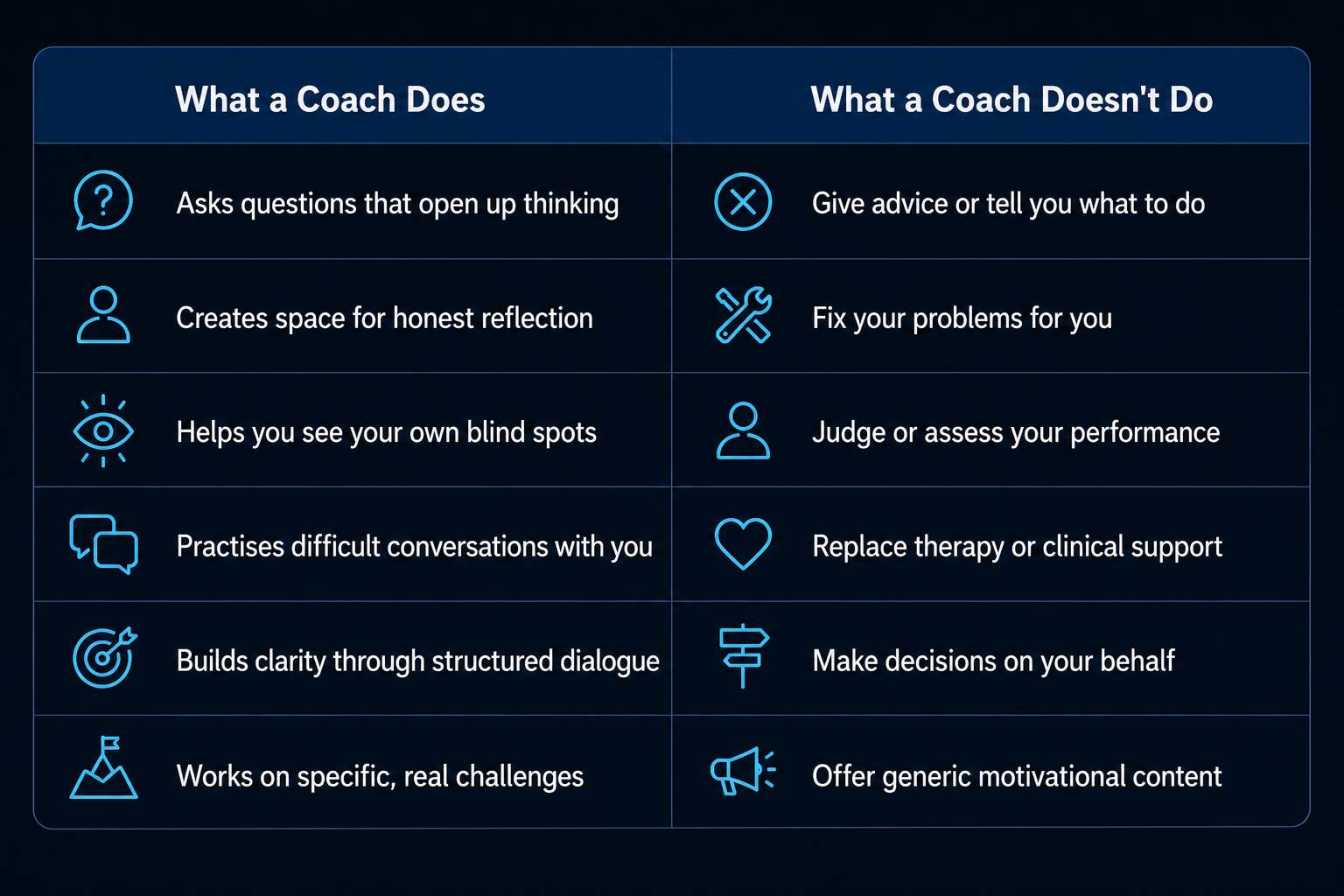
A leadership coach is not a consultant. A consultant diagnoses your problem and tells you what to do about it. A coach doesn't give you answers. Their job is to help you find your own — which turns out to be far more effective, because you're far more likely to act on a decision you reached yourself.
A leadership coach is not a mentor. A mentor has walked the path you're on and shares their experience. That's valuable. But it's different. A coach doesn't need to have led a team of 200 people to help you lead yours better. Their skill is in the quality of the questions they ask, not the depth of their personal experience.
A leadership coach is not a therapist. Therapy heals. It explores the past to understand and resolve what's holding someone back. Coaching is oriented toward the future — toward action, clarity, and behaviour change. The distinction matters practically: coaching is not a clinical intervention, and coaches are not mental health professionals.
Understanding what coaching isn't is often the first thing that unlocks genuine openness to it.
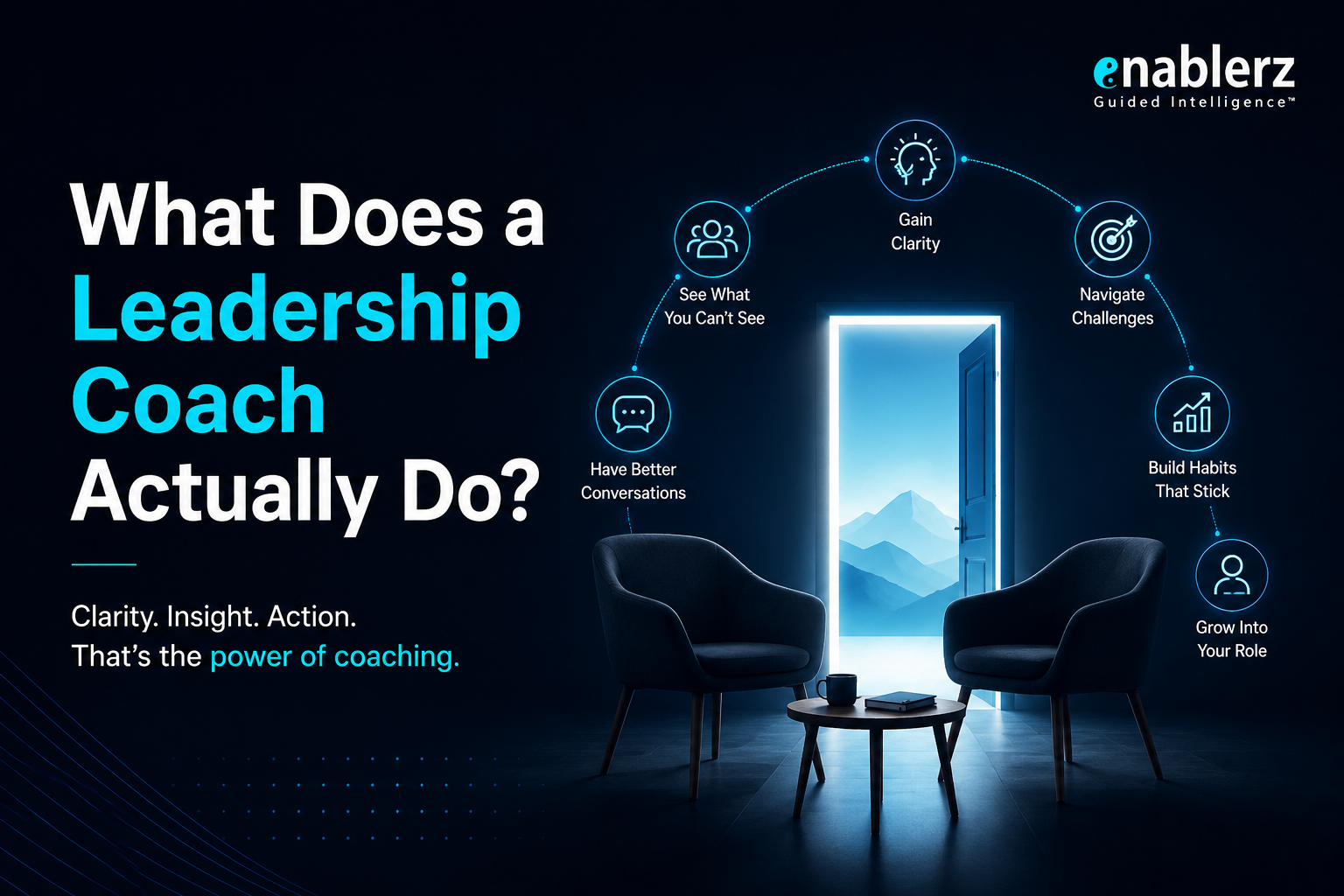
So What Does a Leadership Coach Actually Do?
At its core, a leadership coach creates the conditions for a leader to think more clearly about the things that matter most. That sounds simple. It is simple. But it's also rare, because most of the environments leaders operate in — the meeting rooms, the 1:1s, the performance reviews — are not designed for genuine thinking. They're designed for decisions, updates, and accountability.
A coaching session is different. It's structured, confidential, and entirely about the person being coached. No agenda other than theirs. No outcome other than clarity.
Here's what that looks like in practice:
1. Helping you see what you can't see yourself
One of the most consistent things that happens in coaching is that leaders discover they've been operating with a blind spot. Not because they're unaware or unintelligent — but because certain patterns of thinking become invisible when you're inside them.
A coach holds up a mirror. They reflect back what they're hearing — sometimes in ways that make you stop and think: "I've never actually articulated that before." That articulation is frequently the moment something shifts.
This is especially valuable for senior leaders and managers, who often have very few people willing to offer them honest, unfiltered perspective. Everyone around them is either reporting to them, dependent on them, or managing them. A coach has no stake in your decisions. That independence is what makes the reflection trustworthy.
2. Helping you work through a specific challenge
Most leadership coaching is grounded in something real — a challenge the leader is currently navigating. It might be:
• A difficult team dynamic that's been quietly dragging performance for months
• A transition from individual contributor to people manager (one of the hardest professional shifts anyone makes)
• A decision with significant personal and organisational consequences
• A pattern of behaviour — in meetings, under pressure, in conflict — that keeps producing the wrong results
• A sense of clarity fatigue: performing well on the outside, but increasingly uncertain about direction
A coach doesn't solve these challenges for you. They work through them with you — structuring the thinking, surfacing assumptions, identifying what you actually believe versus what you think you should believe, and helping you move from confusion to clarity.
3. Practising the conversations you're afraid to have
This is one of the most undervalued things coaching does, particularly for managers.
Most managers are never taught how to have difficult conversations. How to give honest feedback without it becoming personal. How to address underperformance without triggering defensiveness. How to disagree with their own manager without damaging the relationship.
Coaching gives you a rehearsal room. You can work through exactly what you want to say — and, more importantly, why you're hesitating — before you're in the room with the person. That preparation isn't just practical. It changes the emotional quality of the conversation when it happens. You're less reactive. More considered. The outcome is different.
4. Building the leadership habits that actually stick
Most leadership development programmes deliver information. They tell you what good leadership looks like. They give you frameworks, models, language.
And then you go back to your desk on Monday with the same inbox and the same team and the same pressures — and none of the conditions needed to actually change how you behave.
Coaching closes this loop. It's not about adding more knowledge. It's about integrating what you already know into how you actually lead, every day. A coach works with you over time — typically in fortnightly or monthly sessions — to identify where the gap between knowing and doing is widest, and to build the specific habits that close it.
What Does a Typical Coaching Session Look Like?
A structured coaching session generally follows a loose arc — though every coach works differently and every session adapts to what the client brings.
Opening: The coachee names what they want to focus on. Not an agenda set in advance by the coach — the coachee chooses the topic, which is itself a practice in self-awareness.
Exploration: The coach asks questions. Not rapid-fire interrogation — carefully chosen questions designed to open up thinking rather than narrow it. "What's underneath that for you?" "What would you do if you already knew the answer?" "What are you most afraid of in this situation?"
Insight: Something shifts. The coachee hears themselves say something they hadn't consciously articulated before. A pattern becomes visible. An assumption gets named and questioned.
Action: Not always a task list — sometimes the action is a shift in perspective. But usually there's a clear next step: a conversation to have, a decision to make, an experiment to run.
Reflection: The session ends with a brief review — what did you take away? What's different now from how you came in?
The whole session is typically 45–60 minutes. The impact, when it lands, is disproportionate to the time invested.
For HR Teams: What Should You Expect From a Coaching Engagement?
If you're evaluating leadership coaching for your organisation, here's what a well-structured coaching engagement typically delivers — and what to watch out for.
What to expect:
• Measurable behavioural change over a sustained engagement (3–6 months is the typical minimum for meaningful impact)
• Improved clarity and decision-making quality for the individuals being coached
• Better team dynamics downstream — because how a leader shows up determines the psychological safety of everyone around them
• Increased retention, particularly of high-performers who often leave not because of the job, but because of their manager
What to watch out for:
• Coaches who offer to "fix" leaders — that's consulting, not coaching
• Programmes with no mechanism for measuring impact — if you can't see it, you can't justify it
• One-size-fits-all approaches that don't adapt to the individual's specific challenges and context
At Enablerz, our ENA platform pairs human coaching expertise with AI-enabled consistency — so the quality of the thinking a leader has access to doesn't depend on whether they can afford a premium executive coach at £300 an hour.
For Individual Managers: Is Leadership Coaching Right for You?
You don't need to be struggling to benefit from coaching. In fact, the leaders who get the most from it are usually already performing well — but they're aware that something about how they're operating isn't quite right. They're hitting their numbers but losing energy. Leading their team but feeling increasingly reactive. Succeeding on paper but quietly unclear about where they're going.
That gap between performance and clarity is exactly where coaching does its best work.
If you've never been coached, the best way to understand it is to try a session. Not a sales conversation. A coaching conversation — where someone asks you a question you haven't asked yourself, and something shifts.
That's what a leadership coach does.
Summary
Ready to See What Coaching Could Unlock?
Whether you're a leader navigating a new challenge or an organization looking to strengthen leadership capability, the right coaching conversation can create clarity, perspective, and meaningful change.
Explore ENA™ or talk to us about your coaching needs.
FAQs
1. What does a leadership coach actually do?
A leadership coach helps leaders think more clearly, identify blind spots, work through challenges, and build stronger leadership habits through structured reflection and dialogue.
2. What is the difference between a leadership coach and a consultant?
A consultant provides recommendations and solutions. A coach helps you find your own answers through questions, reflection, and structured conversation.
3. How is leadership coaching different from mentoring?
A mentor shares their experience and advice. A coach focuses on helping you explore your own thinking, challenges, and solutions.
4. Is leadership coaching the same as therapy?
No. Coaching is generally focused on future goals, clarity, action, and behavioural change. Therapy addresses clinical and mental health concerns.
5. What happens during a leadership coaching session?
You identify what you want to work on, explore it through guided questions, uncover insights, and usually leave with a clear next step.
6. What challenges can a leadership coach help with?
Coaching can help with difficult conversations, team dynamics, management transitions, decision-making, behavioural patterns, and leadership challenges.
7. Who can benefit from leadership coaching?
Leaders, managers, first-time people managers, and high-performing professionals can all benefit from coaching—even when things are already going well.
8. How long does leadership coaching take?
Meaningful behavioural change typically requires sustained engagement. A 3–6 month coaching period is commonly used, depending on the individual's goals and needs.
About Enablerz: Enablerz is an AI-native coaching platform that makes professional coaching accessible to every employee — not just the senior team. Our MOAI™ AI coach and ENA™ enterprise platform serve individuals and organisations across India and beyond.