There’s a moment most HR leaders recognise.
A restructure has been announced. The conversations have been had. And now, sitting with the outplacement programme they’ve put in place, there’s a quiet sense that it could be better — that the employees leaving deserve more than what’s currently on offer.
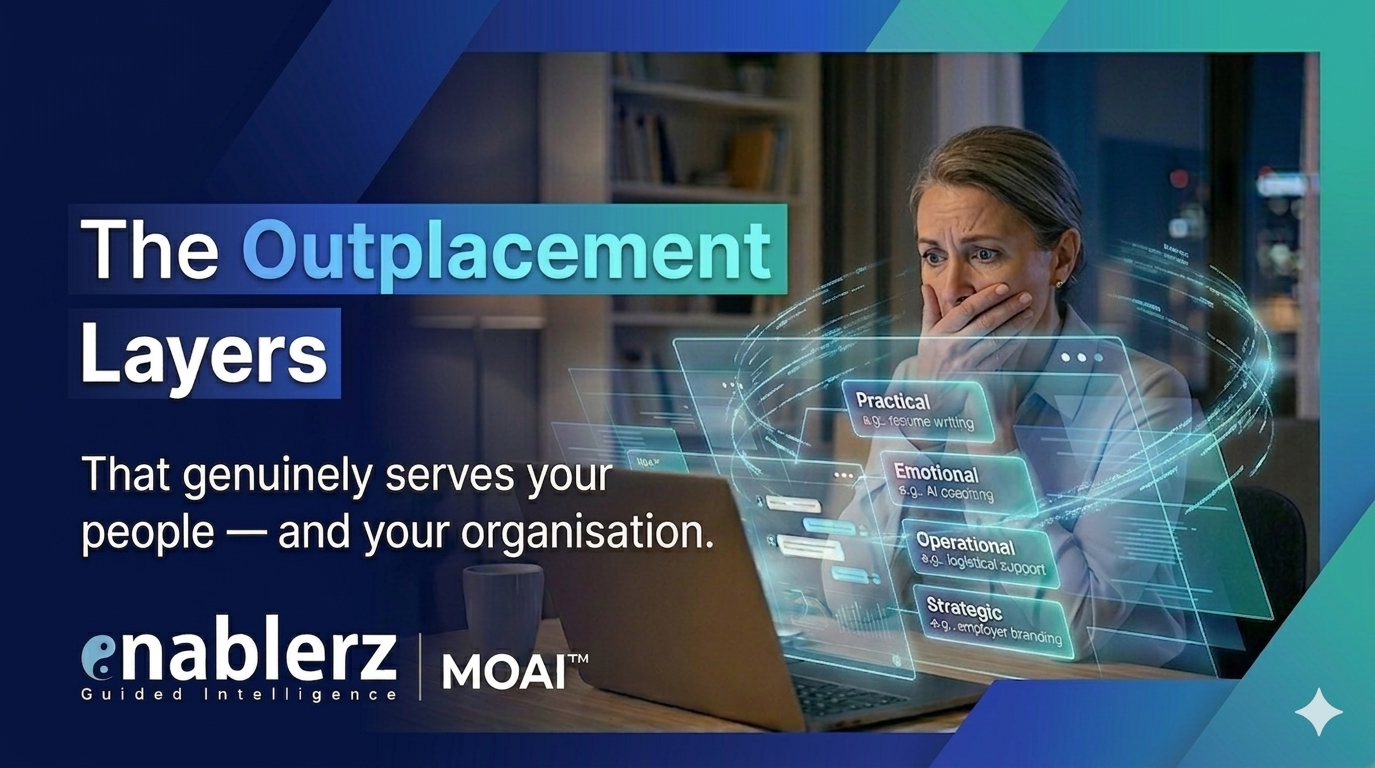
The challenge is knowing where to start. Outplacement has layers: the practical, the emotional, the operational, the strategic. Improving it isn’t one decision — it’s a series of them.
Here are 12 concrete ways to build an outplacement programme that genuinely serves your people — and your organisation.
1. Activate Support on Day One — Not Day Fourteen
The most impactful change most organisations can make costs nothing except intention: decide that support begins the moment the conversation does.
Employees who receive immediate access to coaching and guidance process the transition faster, engage more constructively in their job search, and report significantly better experiences. Delayed activation — waiting for procurement, onboarding, or scheduling — means missing the window when support matters most.
Build your programme so that access is available before the announcement, not after the admin.
2. Extend Coverage Beyond Senior Roles
Tiered outplacement — premium support for leadership, minimal packages for everyone else — is the norm. It shouldn’t be.
Every employee who leaves your organisation carries your employer brand into the market. Every employee who stays is watching how you treat the people who go. Extending meaningful support to every level isn’t just the right thing to do. It’s strategically sound.
AI-enabled coaching platforms now make this economically viable. There is no longer a cost argument for leaving the majority of your exiting workforce without real support.
3. Separate Emotional Support From Tactical Job Search
Most outplacement programmes conflate two very different needs: helping employees process what’s happened emotionally, and helping them navigate what comes next practically.
These are sequential, not simultaneous. An employee who hasn’t processed the emotional impact of losing their role is not ready to optimise their LinkedIn profile. Build in explicit space — through coaching or AI-facilitated conversations — for employees to land emotionally before they engage practically.
4. Make Privacy Non-Negotiable
Outplacement coaching only works when employees feel safe being honest. That means complete confidentiality — no reporting of individual conversations to HR, no manager visibility into session content.
If employees suspect that what they share might reach the wrong ears, they will share nothing of value. Design your programme with privacy as a structural feature, not an afterthought.
5. Personalise the Journey, Don’t Template It
The 28-year-old software engineer considering a career pivot has fundamentally different needs from the 52-year-old operations director navigating their first redundancy after 20 years in one role. A single outplacement template serves neither well.
Effective programmes use AI matching, role-based personalisation, and individual goal-setting to create journeys that feel tailored. The more relevant the coaching feels, the more engaged the employee will be.
6. Train Your Managers for the Conversation
The quality of the outplacement experience often depends on how the initial conversation is handled. Managers who are uncomfortable or inadequately prepared set a tone that the best coaching programme will struggle to overcome.
Invest in preparing managers for redundancy conversations: how to deliver the news with clarity and compassion, how to answer questions honestly, and how to make the transition to outplacement support feel seamless. The programme begins before the employee ever logs in.
7. Use Data to Understand What’s Working
Most organisations have almost no visibility into what actually happens in their outplacement programmes. They know how many employees were enrolled. They rarely know how many engaged, what they found useful, or what outcomes resulted.
Modern platforms generate anonymised engagement data that gives HR leaders genuine insight. Use this data to improve continuously — not just to report to the board that the programme exists.
8. Include Wellbeing, Not Just Career Support
Job loss is a wellbeing event as much as a career event. Anxiety, loss of routine, impact on identity and self-worth — these are real, and they affect how effectively employees can engage in their job search.
The best outplacement programmes address the whole person. MOAI™ by Enablerz is specifically designed to hold this dual dimension: career development and emotional intelligence, in the same coaching relationship.
9. Don’t Neglect the Employees Who Stay
Outplacement is usually designed entirely for those who are leaving. But the employees who remain after a restructuring also need attention. They’re watching how their colleagues are treated. They’re deciding — consciously or not — whether this is still an organisation they want to be part of.
Building a transparent, compassionate exit process is one of the most effective retention strategies available.
10. Give Employees Agency Over Their Journey
Prescriptive outplacement — here is your programme, follow these steps — tends to produce lower engagement than programmes that give employees genuine choices.
Where possible, let employees choose their coaching focus, set their own development goals, and determine the pace of their journey. Agency accelerates progress. It also signals respect.
11. Keep Support Available Beyond the Obvious Window
Most outplacement programmes have a defined timeline — typically 3 to 6 months. Career transitions don’t follow neat timelines. Some employees find roles quickly and still benefit from coaching support as they navigate the early months in a new position.
Build flexibility into your programme rather than cutting support off at an arbitrary date.
12. Connect Outplacement to Your Broader Coaching Culture
Outplacement shouldn’t exist in isolation from how your organisation thinks about development more broadly. The organisations that handle exits best tend to be the ones where coaching is already part of the culture — where employees have experienced its value throughout their time with the company, not only when they’re leaving it.
Transforming your outplacement programme doesn’t require doing all twelve of these things simultaneously. Start with what’s most achievable in your current context — most often, that means faster activation, broader coverage, and better privacy. The rest follows.
Enablerz helps organisations build outplacement programmes that are immediate, scalable, and genuinely personalised — through MOAI™ AI coaching and the ENA™ platform. To find out how, connect with Saurab, Founder at [email protected] / 9833384493 and visit www.enablerzai.com