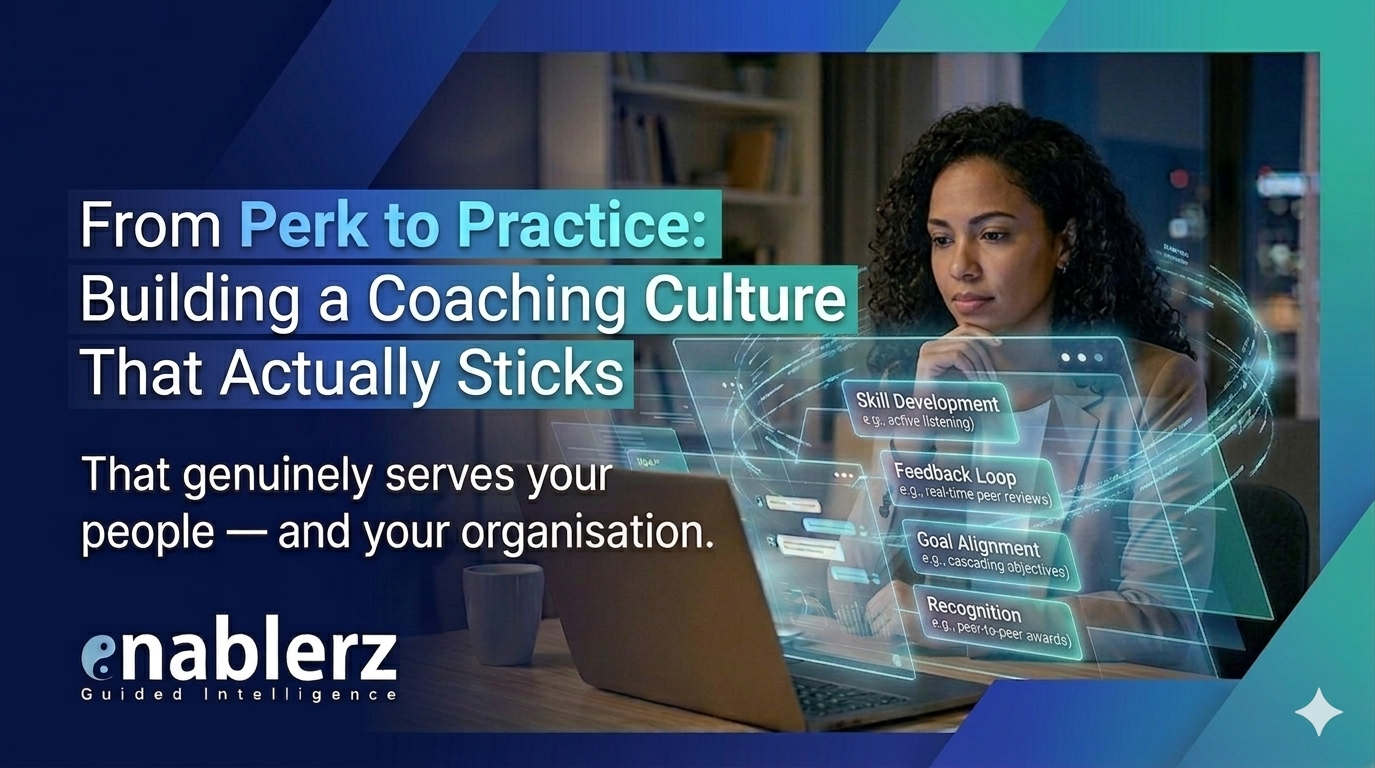
Most organisations that say they have a coaching culture have something more modest: a coaching programme.
There’s a meaningful difference.
A coaching programme is a set of initiatives — a cohort of executive coaches, a leadership development track, perhaps an online platform. It exists. It’s funded. It delivers value to the people who participate in it.
A coaching culture is something deeper. It’s an environment where coaching behaviour — asking before telling, developing rather than directing, making reflection a habit — is woven into how work actually happens. Most organisations have the first. Very few have the second. And the distance between them is where most L&D investment quietly disappears.
Why Coaching Programmes Don’t Automatically Create Coaching Cultures
The assumption that runs through most L&D strategies is that access creates behaviour. Make coaching available, and people will engage with it. It’s a reasonable assumption. It’s also, in most organisations, wrong.
Coaching programmes create pockets of excellence. But these pockets don’t automatically spread. For coaching to become cultural, three things need to be true simultaneously: it needs to be accessible to everyone, it needs to be consistent, and it needs to be modelled from the top. Most programmes achieve one of these. Rarely all three.
The Accessibility Problem
Coaching, in most organisations, is rationed. The result is a system where coaching is associated with seniority or potential. Junior employees learn early that coaching isn’t for them.
This creates two compounding problems. First, the people who could benefit most — those early in their careers — receive the least. Second, when coaching is only available to a select tier, it never becomes a cultural norm. It remains a perk. Something you get if you’re deemed important enough.
Making coaching genuinely accessible — at every level, not just leadership — is the foundational move in building a coaching culture. Everything else builds on this.
The Consistency Problem
Even in organisations with substantial coaching investment, the quality of the coaching experience is wildly inconsistent. It depends on which coach you’re matched with, whether your manager has coaching skills, whether you’re in a team that values reflection.
Consistency requires infrastructure: structured frameworks that create a common language for coaching, AI-enabled coaching that provides a baseline of quality regardless of team or manager, and measurement systems that make coaching outcomes visible. Without this infrastructure, coaching culture is fragile — dependent on individuals rather than embedded in systems.
The Modelling Problem
There is no faster way to signal what an organisation values than through the visible behaviour of its leaders. If senior leaders are visibly engaged in their own coaching — if they talk about it openly, if they bring coaching questions into their conversations with their teams — coaching becomes aspirational rather than remedial.
This is why the top-down element of building coaching culture isn’t optional. The permission to take development seriously has to come from the top.
What a Genuine Coaching Culture Looks Like in Practice
Organisations that have built genuine coaching cultures share observable characteristics. Managers ask questions more than they give answers. One-to-ones are structured around the individual’s goals and growth. Employees talk about their coaching openly because it’s normalised.
Feedback is specific, developmental, and welcomed. People at every level have access to coaching — human coaches for depth, AI coaching for continuity — and they use it. Not because they’re required to, but because they’ve experienced its value.
The Role of Technology in Embedding Coaching Culture
One of the reasons coaching cultures have been difficult to build at scale is that human coaching can’t be everywhere at once. AI coaching changes this — not by replacing human coaching, but by providing the consistent, always-present layer that human coaching alone can never be.
An employee who has access to a thoughtful AI coaching companion — one that knows their goals, holds their context, and is available whenever they need it — has something no previous generation of employees has had: a genuine thinking partner, on demand.
The organisations that make this investment seriously and at scale will build coaching cultures that are structural rather than situational. And that distinction will matter for the people they attract and the performance they sustain.
Enablerz combines MOAI™ always-on AI coaching with ENA™ human coaching to help organisations move from coaching programmes to coaching cultures. To learn more, connect with Saurab, Founder at [email protected] / 9833384493 and visit www.enablerzai.com