Outplacement has a reputation problem.
Ask most employees what they expect when their role is eliminated, and the answers cluster around the same territory: a letter, a severance calculation, maybe a session with an external consultant who hands them a CV template and wishes them luck.
Ask most HR leaders how they feel about their current outplacement offering, and you'll hear a different kind of honesty: "It's not enough, but it's what we can afford." Or: "We cover senior roles well. Everyone else gets the standard package."
The uncomfortable truth is that outplacement — one of the most humanly significant moments in an employee’s relationship with an organisation — has been underinvested in for decades. Not because organisations don’t care. But because the traditional model was never designed for scale, speed, or genuine personalisation.
That’s changing. And the organisations paying attention to how it’s changing are building a meaningful competitive advantage — in culture, employer brand, and talent outcomes.
What Traditional Outplacement Was Built For
To understand why the model is shifting, it helps to understand what it was originally designed to do.
Traditional outplacement emerged in the 1970s and 80s as a corporate response to mass redundancies. Its primary functions were practical: help displaced employees update their CVs, prepare for interviews, and navigate the job market. It was also — let’s be honest — partly a risk management exercise
For a long time, this was sufficient. Job markets moved more slowly. Career paths were more linear. The model that emerged was fundamentally coach-centric and session-based — an employee in transition would meet with a consultant periodically to work through CV drafts, practise interviews, and discuss job search strategy.
This model has two structural limitations that have become impossible to ignore.
-
It doesn’t scale economically. A high-quality, coach-delivered programme costs significantly per head. The result is tiering — comprehensive support for senior leaders, bare-minimum packages for everyone else.
-
It’s asynchronous in a world that demands real-time support. Career transition is not a neat, scheduled process. The moment someone is told their role no longer exists, they need support — immediately. Not in three days when their first consultation is booked.
What Employees in Transition Actually Need
The research on career transition is clear — and more nuanced than most outplacement programmes acknowledge.
Employees navigating job loss aren’t just dealing with a practical challenge. They’re managing a psychological one. Identity, self-worth, financial security, professional relationships — all disrupted simultaneously. Effective support addresses both layers: the emotional foundation first, the tactical job search second.
What this means practically is that support needs to be:
- Immediate. The days immediately following a role elimination are when support matters most.
- Continuous. Career transition unfolds over weeks and months. Support needs to be present across the entire arc.
- Personalised. A templated programme serves no one particularly well.
- Private. Employees need to be honest about their fears, doubts, and ambitions without worrying that what they say will reach their former manager.
Where AI Changes the Equation
The emergence of AI coaching, specifically, agentic AI that can hold structured, multi-turn coaching conversations, doesn’t solve every problem in outplacement. But it solves the two structural ones directly.
It makes comprehensive coverage economically viable. An AI coaching platform can be deployed to every exiting employee — regardless of level, function, or geography — at a fraction of the per-head cost of traditional models. The economics of “every employee deserves real support” stop being aspirational and become operational.
It provides genuinely continuous, real-time support. When an employee is lying awake at 1am wrestling with whether they should take the first offer they receive, the support is there. When they need a confidence reset before an important interview the next morning, it’s available.
What good AI coaching can do and what MOAI™ by Enablerz is specifically designed to do — goes further than simple availability. It holds context across conversations, adapts to the individual’s goals and emotional state, and asks the kinds of questions a skilled coach would ask. What it does not do is replace the depth and empathy of a skilled human coach. And it shouldn’t try to.
The Case for a Hybrid Model
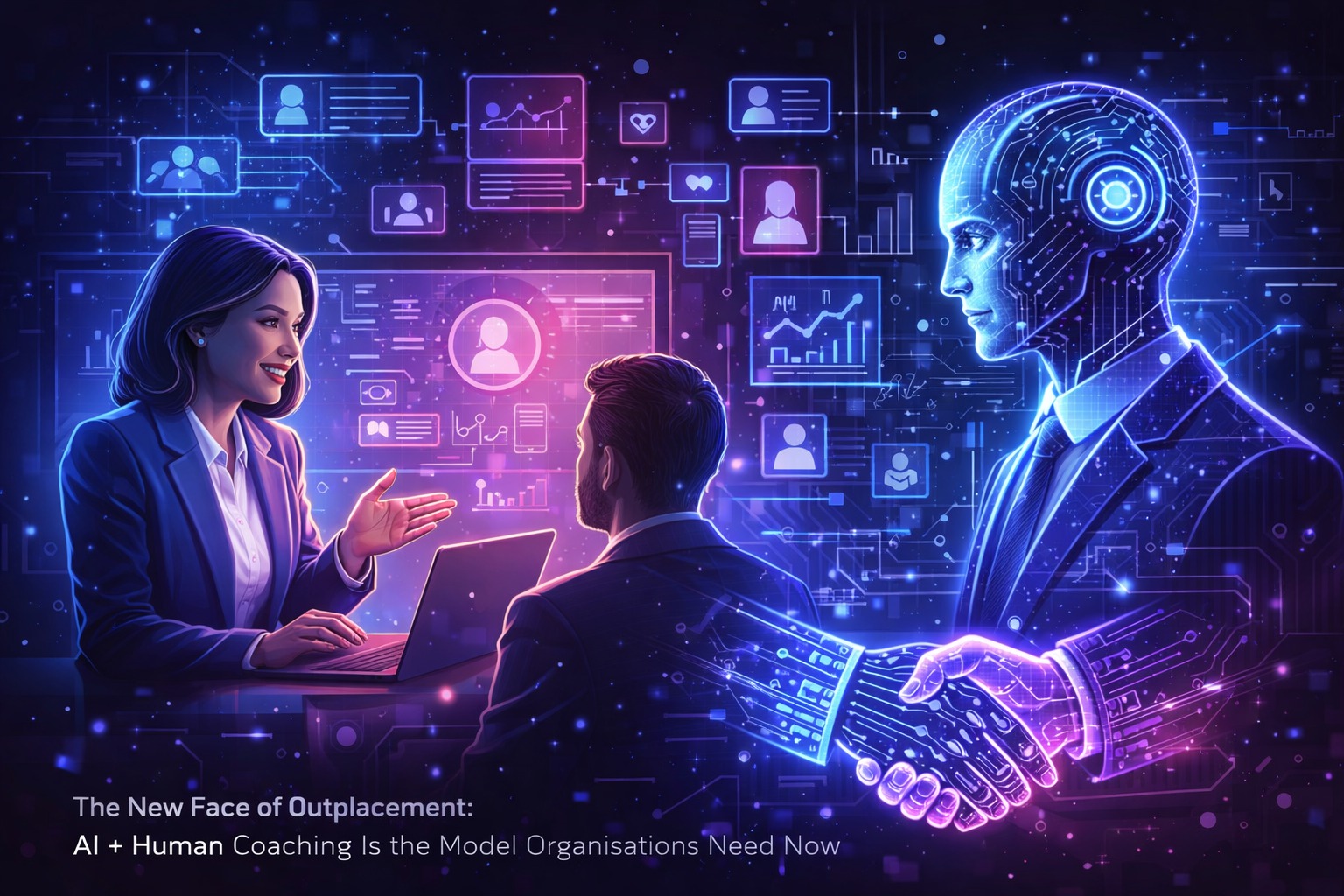
The most effective outplacement programmes we’ve seen aren’t choosing between AI and human coaching. They’re building a model where both play to their genuine strengths.
An AI coaching companion handles the always-on layer — present from Day 1, available whenever the employee needs it, managing the continuity of the coaching relationship across the full arc of transition.
Human coaches step in for the work that genuinely requires human depth: complex career pivots, high-stakes interview preparation, emotional support for employees navigating particularly difficult circumstances.
This isn’t a compromise. It’s a better model than either approach alone. The employee gets more. The coach does their best work. The organisation gets measurable, consistent outcomes across its entire exiting workforce — not just the senior tier.
What This Means for HR Leaders
If you’re responsible for outplacement in your organisation, the shift toward hybrid AI + human models creates a practical opportunity worth taking seriously.
- Coverage becomes a choice, not a constraint. Historically, tiered outplacement was a budget reality. With AI-enabled delivery, offering every exiting employee meaningful support is now operationally and financially achievable.
- Speed of deployment becomes a differentiator. Organisations that activate support on the day of the conversation handle transitions differently. Employees feel it. The culture around exits changes.
- Outcomes become measurable. Hybrid models generate engagement data, progression insights, and outcome tracking that make it possible to quantify the impact of your investment.
- Employer brand is shaped in these moments. The way an organisation handles departures is remembered by those who left and, crucially, by those who stayed.
A Different Way to Think About Exits
Outplacement has historically been treated as a cost to manage. The evidence — and the technology — now point to a different framing: it’s an investment in culture, brand, and the dignity of people who have contributed to your organisation.
The model to make that investment practical and scalable now exists. AI + human coaching isn’t the future of outplacement. For the organisations paying attention, it’s already the present.
Enablerz is a global AI-native enterprise coaching platform combining MOAI™ — always-on agentic AI coaching — with ENA™, an enterprise coaching platform powered by certified human coaches. To see how Enablerz approaches outplacement, contact Saurab, Founder at [email protected] / 9833384493 and visit www.enablerzai.com